Sunlight falls on every roof, free. This department explains how to understand your electricity needs, judge whether solar fits them, care for batteries safely, and cut waste before spending on equipment.
Aerial view of solar arrays and aquaculture ponds. Photo: Benlisquare · CC BY-SA · source
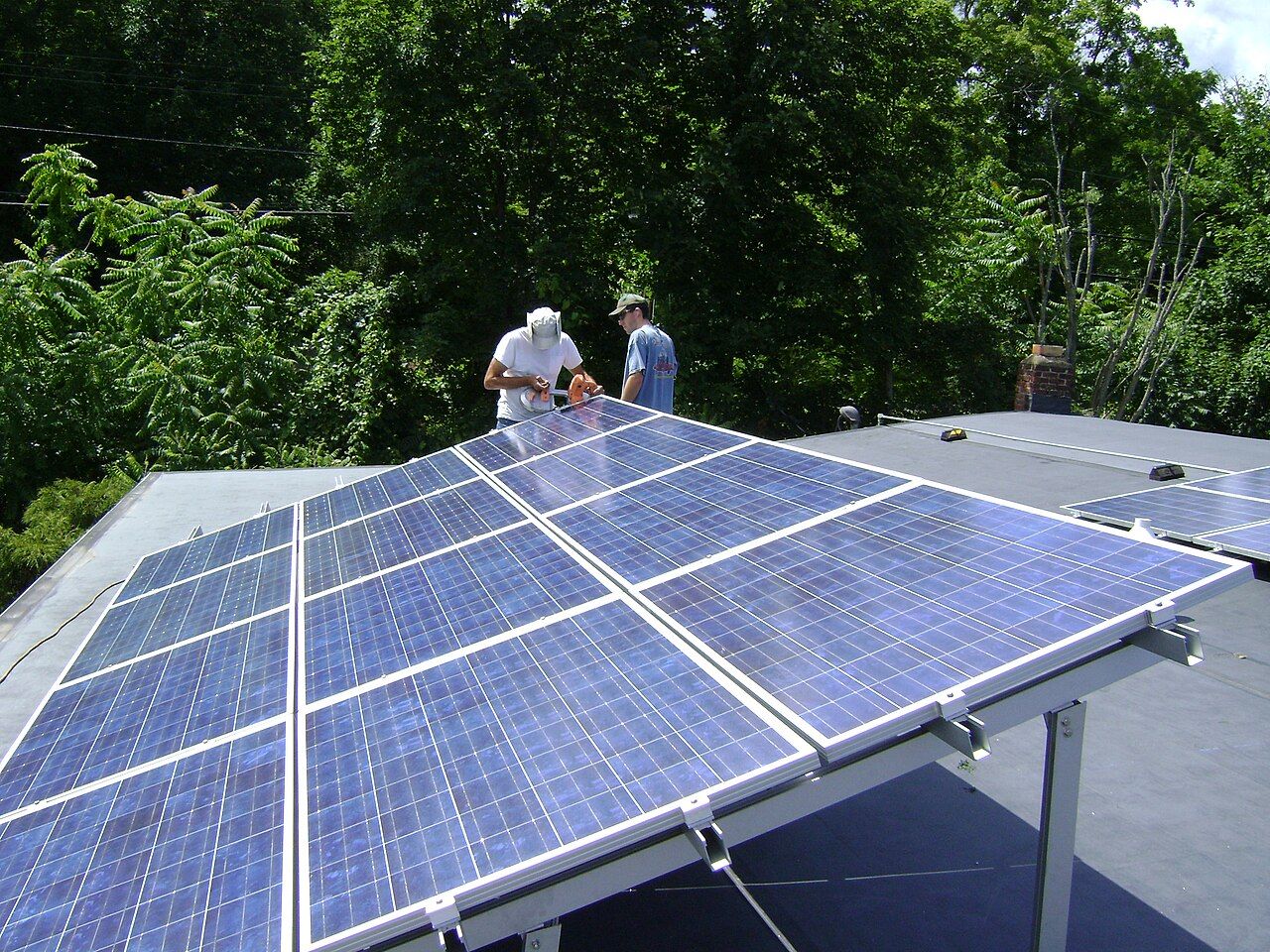
Installing solar panels on a rooftop. Photo: Lucas Braun · CC BY-SA 3.0 · source
A wind turbine standing in green farmland. Photo: Achim Lammerts (Syntaxys) · CC BY-SA 4.0 · source
Five guided solutions
Each solution follows the Global Solutions pattern: the problem, how it works, the steps, the outcome you can expect — and the boundary where a licensed professional must take over.
Solution 1 of 5
Know your daily electricity need first
The problem. Solar systems are sold by panel count and bought by regret: undersized systems disappoint, oversized ones waste money — both begin with an unmeasured load.
How it works. Your need is arithmetic: every appliance's watts × its hours of use, summed into daily watt-hours. A fridge cycling all day and lights for five hours decide the system far more than the television's size suggests.
Practical steps
List every appliance with its wattage (on its label or manual).
Write honest hours of use per day for each, season by season if they differ.
Multiply watts × hours and add the column: that is your daily need in watt-hours.
Separate essentials (lights, phone, fridge) from luxuries for outage planning.
Use the Solar Estimator in the Calculator Centre to turn the total into a preliminary system size.
Expected outcome. A number, not a guess — the foundation of every sensible solar decision.
⚠ Professional boundary. System design for a real installation — wiring, protection, mounting — belongs to a qualified solar installer working to your electrical code.
Solution 2 of 5
Size a small solar system (preliminary)
The problem. Panels are rated in laboratory sun; your roof delivers less — heat, dust, angle and wiring all take their share, and cloudy days take more.
How it works. The preliminary method: divide daily watt-hours by your location's peak sun hours, then add a margin for system losses (a factor of about 0.75 is a common planning allowance). The result is a starting capacity to discuss with installers — not a design.
Practical steps
Start from your measured daily need (previous topic).
Find your area's typical peak sun hours from a credible solar resource source or installer.
Divide need by sun hours, then divide by 0.75 for losses.
Round up to a practical panel combination and note the assumption beside it.
Get at least two installer quotations against the same stated requirement.
Expected outcome. Comparable quotations and a system sized to your life, not to a sales target.
⚠ Professional boundary. Preliminary sizing is education, not engineering. Battery banks, controllers and protection must be professionally specified.
Solution 3 of 5
Batteries: capacity, care and safety
The problem. The battery is the heart and the hazard of an off-grid system: it decides how long lights last at night, and it punishes neglect and abuse alike.
How it works. Capacity in amp-hours × voltage gives stored watt-hours; using only part of it (depth of discharge) multiplies its lifespan. Lithium and lead-acid differ in price, depth tolerance and care — both demand ventilation, correct charging and respect.
Practical steps
Calculate nightly need first; size storage to the nights of autonomy you truly require.
Ask the seller, in writing, the battery's usable capacity and expected cycle life.
Install with correct cable sizes, fuses and ventilation, by a qualified person.
Keep terminals clean, tight and protected; check levels on serviceable types.
Plan end-of-life return or recycling from the day of purchase.
Expected outcome. Stored power that lasts years, not months — and a home kept safe around it.
⚠ Professional boundary. Batteries can deliver fatal currents and some types emit gases. Installation and major service are professional work, full stop.
Solution 4 of 5
Cut the load before you buy panels
The problem. The cheapest watt is the one never used. Efficient lighting and appliances routinely shrink the required system by a third — savings that recur every single day.
How it works. Efficiency first is arithmetic: an LED using 8 watts replaces a 60-watt bulb doing the same job; that difference, multiplied by hours and years, is panels and batteries you never buy.
Practical steps
Replace the most-used lights with quality LEDs first.
Retire or repair appliances that run hot, loud or constantly.
Shift heavy tasks (ironing, pumping) to sunny hours when solar is abundant.
Switch off standby loads at night with one accessible switch.
Re-measure your daily need after the changes — then size the system.
Expected outcome. A smaller, cheaper system doing the same job — with lower bills even on grid power.
⚠ Professional boundary. Buy efficient appliances from reputable sellers; counterfeit 'efficient' products waste money twice.
Solution 5 of 5
When a microgrid makes sense
The problem. For a single home, a single system; but a school, clinic, water point and twenty homes together may justify a shared microgrid — one generation and storage plant with distribution to many users.
How it works. Microgrids succeed on organisation as much as engineering: agreed tariffs, honest metering, a maintenance fund and clear ownership. The technology is the easy half; the governance decides whether it is still running in year five.
Practical steps
Map the community's anchor loads: clinic, school, water, businesses.
Estimate combined daily demand and its timing across the day.
Agree ownership, tariffs and the maintenance fund before any equipment arrives.
Plan metering that every user can read and trust.
Train local operators and document every procedure.
Expected outcome. Reliable power shared fairly — and a system the community can keep alive.
⚠ Professional boundary. Community systems involve electrical distribution and public safety law; design and approval by licensed engineers and authorities are mandatory.